TL;DR — Quick checklist
- Confirm legality & licensing for your province before buying.
- Start with non-lethal tools (pepper spray, stun devices) for immediate, legal options.
- If buying a firearm: choose a weapon that fits your home layout, ammo availability, and training level (shotgun for short-range stopping power; pistol for maneuverability).
- Prioritize safe storage, training, and de-escalation over any specific model.
- If unsure, consult local police or a licensed dealer and get professional training.
1) Start with the fundamental question: Why do you want a tactical weapon for home defense?
Be honest and specific. Common legitimate reasons:
- Preventing a home invasion/defending family during an immediate threat
- Rural property security where police response is slow
- Part of a broader household emergency plan
If your main goal is personal safety in busy urban settings, non-lethal options and layered security usually make more sense than jumping straight to firearms.
2) Legal foundation — what you must know (Pakistan)
- Owning and carrying firearms in Pakistan is governed by federal and provincial laws; licenses are required for non-prohibited bore weapons and there are restrictions and zones where weapons are forbidden. Always start by reading the Pakistan Arms Ordinance and checking your provincial rules.
- Recent local clarifications (e.g., provincial standing orders) can change carrying rules — verify with your local police/arms office. For example, Sindh issued a clarified standing order on concealed carry for licensed holders in 2026. Do not assume anything is permitted without a valid license.
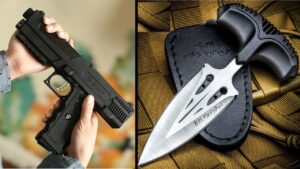
- Non-lethal self-defense tools (pepper spray, many stun devices) are widely available in Pakistan and often legal for civilians — but some items (knuckle dusters, certain tactical knives) may be restricted. Check local laws before purchasing.
Action: Before spending money, visit your local arms/licensing office or their website and ask: “What’s required to legally possess and store X in my district?” Keep documentation.
3) Decide the category that fits your home & comfort level
Below are common categories that Pakistani buyers choose — strengths, weaknesses, and local considerations:
Non-lethal options (best starter choices)
- Pepper spray / OC spray — cheap, light, legal in many places, immediate disabling effect; ideal for family members and quick escapes.
- Stun guns / tasers (where legal) — effective at close range; check legality and quality (buy from reputable sellers).
- Impact tools / batons — simple and cheap, but they require training and may be legally sensitive depending on the item.
Why choose non-lethal first? They reduce risk of lethal escalation, are easier to store safely, and are often legally simpler.
Firearms (if you can legally own and are willing to train)
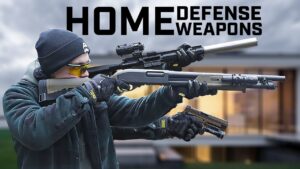
- 12-gauge shotgun (short barrel / tactical style) — excellent stopping power at short range, lower risk of over-penetration if you select appropriate loads (buckshot) and use proper angling in home defense. Favored by many home-defense experts.
- Handguns (9mm compact/full-size) — more maneuverable inside tight rooms; require training for accurate, safe use and careful selection of defensive ammunition to limit over-penetration.
- Pistol-caliber carbines (9mm PCC) — combine rifle-like handling with pistol ammo; easier to shoot than a handgun for many people in stressful situations.
- Rifles — generally not ideal for dense, populated homes due to over-penetration risk unless you live in isolated rural areas and have clear justification/training.
Local note: Ammo availability, cost, and serviceability matter — pick calibers and make that local gunsmiths stock and can service.
4) How to evaluate a specific weapon — a practical scoring checklist
Score each weapon option 1–5 on the following for your household:
- Legal compliance (license, permitted type): 1–5
- Stopping power for short-range intruder scenarios: 1–5
- Risk of over-penetration (inside your neighborhood): 1–5 (lower is better)
- Ease of training and safe handling (for family members): 1–5
- Ammo availability & cost in Pakistan: 1–5
- Storage and safe-lock compatibility (safe, trigger lock): 1–5
Add scores to help decide. A high overall score with strong training & safe storage beats a “cheaper but risky” choice.
5) Training & competence — non-negotiable
- Formal training: Do a certified course (handling, clearing malfunctions, marksmanship, legal use-of-force basics). RAAD Tactical offers gear and can connect you with trainers and courses for safe, legal training.
- Regular drills: safe dry-practice (empty gun), reload drills, family emergency plans, and escape routes.
- Decision-making under stress: train for de-escalation and escape — most experts stress avoiding confrontation whenever possible.
Rule: If you or someone in your household can’t commit to training, choose non-lethal options or strengthen physical security instead.
6) Safe storage, access control & family safety
- Approved gun safe / heavy lockbox anchored to structure. Store keys/combination securely — not under a mattress.
- Trigger locks & chamber flags for added safety.
- A separate, taught family plan: who can access the weapon and under what circumstances. Never leave guns loaded in common areas where children or guests roam.
- Document serial numbers and keep purchase/ownership papers in a safe place (required for licensing and helpful if items are lost/stolen).
7) Ammunition, loads, and over-penetration considerations
- For home defense in populated houses or apartments, buckshot (12-gauge) or specifically designed self-defense pistol rounds with controlled expansion reduce the danger of through-walls hits compared to full-metal jacket rifle rounds.
- Avoid high-penetration rifle rounds inside houses unless you understand ballistic behavior and live in a very isolated setting.
8) Buying & verification — how to avoid scams or illegal products
- Buy from licensed dealers and insist on paperwork (sales invoice, warranty, license checks). Check credentials of the shop.
- When buying used: inspect bore, serials, headspace (if applicable), and get a gunsmith check.
- Do not buy black-market weapons — legal and safety risks are enormous.
9) Sample home-defense setups (realistic)
- Urban apartment — minimal risk tolerance: pepper spray + reinforced door/frame + doorbell camera + alarm system. Train family in escape routes.
- Suburban family home — moderate risk: 12-gauge pump shotgun (short barrel with safe storage), pistol for bedside (in a biometric lockbox), training + monthly dry drills.
- Rural property — high self-reliance: pistol-caliber carbine or shotgun, accredited training, layered perimeter security (floodlights, alarms), and clear rules for firearm access.
10) Common mistakes & how to avoid them
- Buying a weapon before confirming legality and storage — wrong order.
- Overestimating ballistic performance — many owners underestimate over-penetration risk.
- Neglecting training and safe storage.
- Relying on online “reviews” alone — always test and consult local experts.
11) FAQ
Q: Is it legal to use a firearm in self-defense in Pakistan?
A: Pakistani law allows self-defense but use of force must be reasonable and proportionate — and possession/carry must be legal and licensed. Always verify local rules.
Q: Can I carry a licensed home defense weapon outside the house?
A: Carrying is regulated and often restricted; some provinces have recently clarified licensed carrying rules (e.g., Sindh), so confirm with local authorities.
Q: What’s the easiest legal first step for most Pakistanis?
A: Buy a quality pepper spray and enroll in a self-defense course while you research licensing and training for firearms.
12) Final recommendations — practical next steps
- Get a physical or online copy of the Pakistan Arms Ordinance and confirm provincial rules.
- Buy a legal non-lethal tool (pepper spray) and start a basic personal safety course.
- If you still want a firearm: decide category (shotgun / pistol), score options using the checklist above, and only buy from a licensed dealer after verifying license & paperwork.
- Invest in a quality safe, trigger lock, and at least one professional training course.
- Build a written family emergency plan and do monthly drills.
Also Read: Where to Buy Military Gear in Pakistan? | The Ultimate RAAD Tacticals Guide