(Pakistan-focused, deeply practical guide for serious buyers and RAAD Tactical readers)
Brand note: this guide is written to help readers of RAAD Tactical and buyers across Pakistan.
Legal reminder: always confirm local rules (Pakistan Arms Ordinance, 1965) before purchasing. Pakistan Arms Ordinance, 1965.
TL;DR — the single most important idea
Price matters — but the true cost of a tactical weapon is price + safety + training + ammo & maintenance + downtime. Spend in the places that reduce long-term risk: reliable platform, correct caliber, local ammo availability, safe storage, and training. (Quotes below show local ammo and market realities.)
Why this matters in Pakistan (short)
- Availability and prices of ammunition and spare parts vary by city and dealer; pick a weapon whose ammo is reliably stocked near you. Example local suppliers list 9mm and 12-gauge stock and price examples online.
- Legal compliance and paperwork are non-negotiable: licenses, prohibited-bore rules and provincial clarifications affect what you can lawfully own and how you can use it. Always confirm with official guidance.
How to think about price vs performance — a simple framework
Treat every purchase as an investment. Ask: what will this weapon do reliably for the next 5 years under Pakistani availability and usage conditions?
Score each option on these 6 axes (1–10), then weight by importance for your needs:
- Reliability (30%) — will it run without frequent failures?
- Ammo availability & cost (25%) — can you source the rounds locally at reasonable cost?
- Lethality & stopping power appropriate to use-case (15%) — not “more is always better” — choose what fits your environment.
- Over-penetration / collateral risk (10%) — critical in dense neighborhoods. See ammo choices below.
- Maintainability & spare parts (10%) — can local gunsmiths service it?
- Upfront price + lifecycle cost (10%) — purchase price + expected ammo & servicing for 3 years.
Multiply each score by weight, add up — use this objective total to compare models rather than emotional marketing.
The true cost (example math)
Upfront cost is obvious. Don’t forget recurring costs:
- Purchase price (example: basic 9mm pistol or imported copy: PKR 60,000–320,000 depending on make/quality). Example local listings show wide ranges.
- Ammo cost per round × expected practice rounds per month (e.g., 9mm local packs or 12-gauge boxes). Local shops show box prices that vary widely; factor transport/import delays.
- Maintenance (gunsmith service, replacement springs/parts) — estimate PKR 5,000–20,000/year depending on platform.
- Secure storage (biometric safe or heavy lockbox) — PKR 25,000–120,000.
- Training (basic + annual refresher) — PKR 8,000–40,000 per person per course.
Total 3-year cost example (budget 9mm): Purchase PKR 80,000 + ammo PKR 54,000 (1000 rounds) + training PKR 24,000 + storage PKR 35,000 + service PKR 10,000 = ≈PKR 203,000. Use this to compare with other platforms (shotgun, PCC, etc.).
Weapon categories — where price and performance typically fall
I’ll list common home-defense / tactical categories and the main tradeoffs for Pakistan buyers.
1. Compact/Full-size 9mm pistols — balanced choice
- Performance: Good compromise of muzzle energy, magazine capacity, and controllability.
- Price: Widely variable — cheaper “copies” vs imported makes. Check local dealer pricing and warranty.
- True cost factors: Ammo (9mm) tends to be more available and cheaper per round than many rifle calibers in Pakistan. Spare magazines and holsters are common.
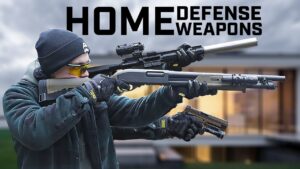
2. 12-gauge pump shotgun — high stopping power at short range
- Performance: Excellent close-range stopping power with the right load (buckshot). But over-penetration can be a concern depending on load and residence.
- Price: Shotguns and 12-gauge ammo are commonly available locally; check brands and load types (buckshot vs birdshot).
- True cost factors: Cheaper ammo per shot vs quality pistol hollow points but higher risk of property/neighbor damage.
3. Pistol-Caliber Carbines (PCCs, 9mm carbines)
- Performance: Easier to shoot than handguns for many people; often better accuracy under stress.
- Price: Typically more expensive than basic pistols but cheaper to shoot if using the same 9mm ammo. Spare parts may be less common locally.
- True cost factors: Good balance for households wanting controllability + ammo commonality.
4. Rifles (high-velocity rifle calibers)
- Performance: High terminal power but poor choice for close quarters in populated areas due to over-penetration risk. Only consider isolated properties with strong justification.
Practical rules for choosing the best value (price→performance)
- Buy the most reliable platform you can afford in the caliber you can feed locally — reliability > exotic features.
- Favor common calibers (e.g., 9mm, 12-gauge) because they reduce ammo & spare-parts headaches and lower lifecycle costs.
- Don’t over-buy power that increases collateral risk — choose defensive ammunition designed to expand and limit through-walls when appropriate.
- Factor training into budget — a cheaper gun with no training is a dangerous false economy.
- Plan for storage & legal fees — a cheap gun stored unsafely exposes you to legal and human costs.
How to evaluate models in practice — checklist to use at the shop
- Does the dealer hold a valid license / paperwork? (avoid informal or black-market sellers).
- Can the local gunsmith service the model or are parts easily imported?
- Are magazines, springs and common parts stocked locally? (inspect shop listings; many shops list ammo and parts online).
- Is the caliber available locally year-round? (ask shop and check online listings).
- Can you test-grip the weapon and dry-run the controls? (feel is real; marketing specs are not).
- Does the seller provide a clear invoice that will be acceptable for licensing paperwork? (you’ll need this).
Budget tiers — practical recommendations (Pakistan market)
Price bands are approximate — check local listings for current prices before buying.
- Entry / Budget (PKR 40k–90k): Cost-effective 9mm “first copies” or older used pistols; expect higher maintenance. Good if on tight budget but budget more for training & spares. Check local shops for used listings.
- Mid (PKR 90k–250k): Reputable imported pistols or quality local/regionally sourced shotguns; better resale and parts ecosystem. Best value for most buyers.
- Premium (PKR 250k+): Top imported pistols or specialized PCCs/carbine systems with warranties and better reliability — lowers downtime but higher upfront cost.
Accessories & performance-increasing upgrades — what’s worth spending on
- Sights: A quality sight (fiber-optic or red dot for PCCs) dramatically improves practical accuracy. Worth the money.
- Holsters & lockboxes: Invest in a good holster + biometric bedside safe — these reduce accidental access and legal risk.
- Spare magazines: Never buy a weapon without at least 2–3 extra mags.
- Maintenance kit & spare springs: Small spend upfront saves repair bills.
- Training & a match-grade trigger job only after you’re competent.
Local market & availability — quick notes & citations
- Pakistani online stores and local dealers commonly list 9mm and 12-gauge ammunition, and prices/availability vary widely by seller; checking multiple suppliers helps avoid stockouts and price shocks.
- Local dealers (including established tactical gear stores) also sell accessories and can recommend trainers; check dealer reputation and verify licensing.
Avoiding common buyer mistakes (short)
- Mistake: Buying the “cheapest” model without checking spare parts -> false economy.
- Mistake: Overlooking ammo logistics (import delays).
- Mistake: Skipping training because it “costs too much.”
Fix: Use the scoring framework above and factor 3-year running costs into your decision.
Also Read: How to Choose the Right Tactical Weapon for Home Defense